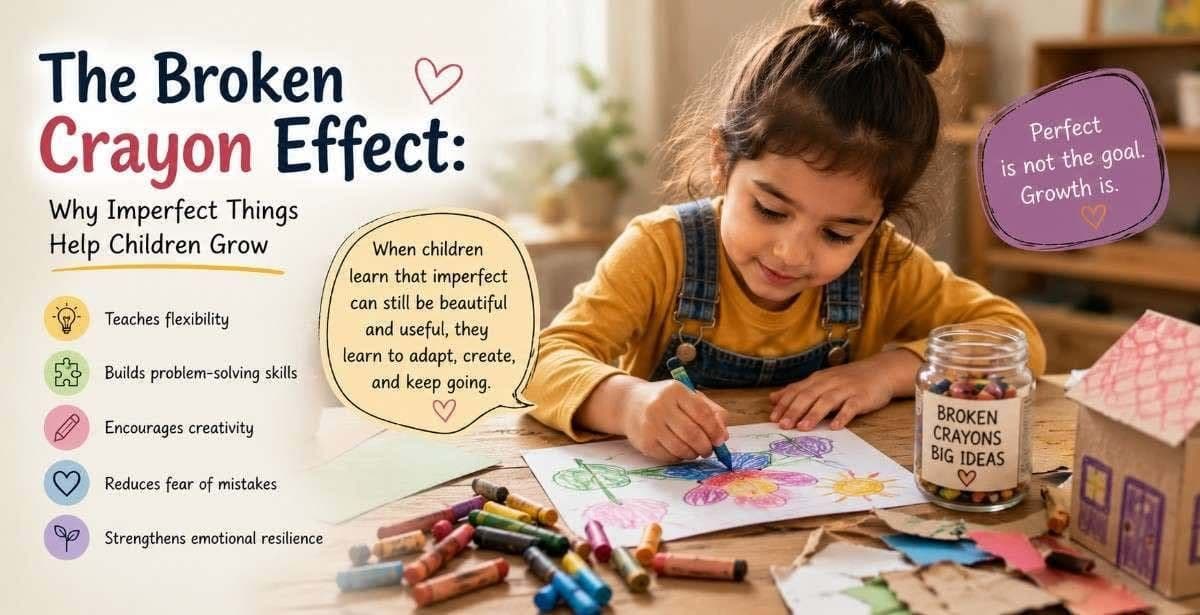
The Broken Crayon Effect: Why Imperfect Things Help Children Grow
Children are often drawn to perfect-looking toys, neat drawings, and clean pages. But some of the most meaningful learning happens through broken, mismatched, unfinished, or imperfect moments.
By Jewel Centre for Autism ·
Introduction
Children are often drawn to perfect-looking toys, neat drawings, and clean pages. But some of the most meaningful learning happens through broken, mismatched, unfinished, or imperfect moments. A cracked crayon, a torn piece of paper, a crooked tower, or a wrinkled drawing can become the start of creativity, resilience, and confidence.
The Broken Crayon Effect is a simple idea: when children are allowed to work with imperfect materials and accept imperfect results, they learn that beauty, value, and success do not always come in neat packages.
Why Imperfection Matters
1. Teaches Flexibility
- A broken crayon still colors.
- A torn sheet of paper can still become art.
- Children learn that imperfect things can still be useful.
- This helps them adapt instead of giving up.
2. Builds Problem-Solving Skills
- If a puzzle piece is missing or a toy is incomplete, children begin to think of alternatives.
- They learn to ask, "What else can I use?" and "How can I make this work?"
- This encourages flexible thinking and creative problem-solving.
3. Encourages Creativity
- Imperfection often opens the door to imagination.
- A broken box becomes a house.
- A cardboard strip becomes a road.
- A half-used object can spark a brand-new idea.
4. Reduces Fear of Mistakes
- Children who only see perfect results may become afraid of failing.
- When adults model comfort with mess, mistakes, and unfinished work, children learn that mistakes are a natural part of learning.
- They become more willing to try, explore, and learn through trial and error.
5. Strengthens Emotional Resilience
- Life is full of situations that are not ideal.
- Practicing with small imperfections helps children build patience, confidence, and resilience.
- They learn to keep going even when things do not go as planned.
Simple Ways to Use This Idea at Home
- Keep a "broken crayons" jar and let children use the pieces for coloring.
- Give children scrap paper, old magazines, and leftover cardboard for art projects.
- Encourage them to repair, rebuild, or redesign toys and blocks in new ways.
- Praise effort, creativity, and imagination rather than only neatness and perfection.
- Show children that adults also adapt when things are not perfect.
Final Thoughts
Sometimes the most beautiful ideas begin with something broken, unfinished, or unexpected. By embracing imperfection, we help children become creative thinkers, confident problem-solvers, and resilient learners.