Is a 2-Year-Old Considered a Late Talker?
Learn the signs of late talking in 2-year-old children, typical speech milestones, possible causes of speech delays, and when parents should seek professional guidance.
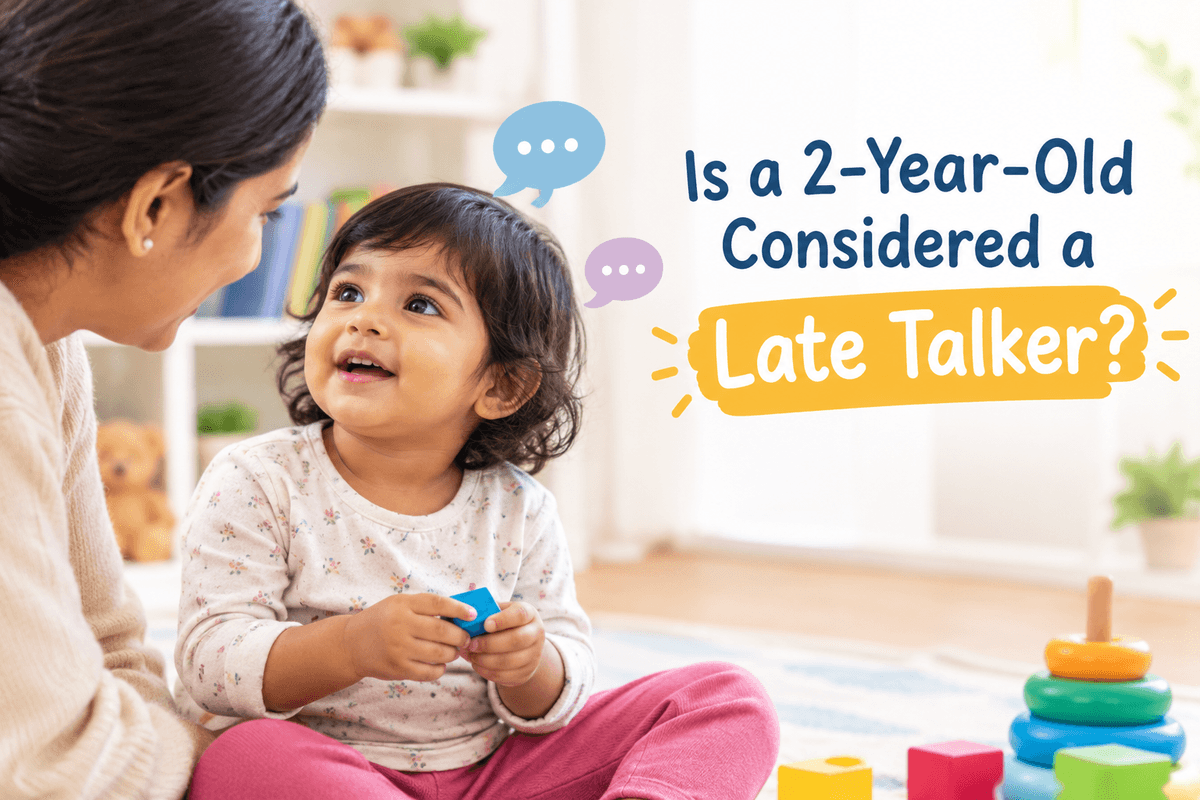
Your neighbor's toddler is chatting away in full phrases. Yours points, grunts and gives you a very expressive look, but not much else. You've probably heard "he'll talk when he's ready" a dozen times by now. Maybe you've even Googled "2-year-old not talking" at midnight.
So, is a 2-year-old considered a late talker? Sometimes, yes. But the label has a specific meaning, and it helps to know what it covers (and what it doesn't) before you decide what to do next.
What Exactly Is a Late Talker?
A late talker is usually a toddler between 18 and 30 months with a small spoken vocabulary for their age. The key part is that everything else looks typical. They understand what you say, play well, use gestures like pointing, and hit their motor and social milestones on time. Talking is the only thing lagging.
It's also a fairly common situation. Estimates for 2-year-olds range from roughly 10% to 15%, so you're far from alone.
What Should a 2-Year-Old Be Saying?
By age 2, most toddlers:
- Use at least 50 words (some sources put the typical range closer to 50 to 75)
- Put two words together on their own, like "more juice," "doggie gone" or "eat cookie"
- Are understood by their parents about half the time
That second point trips people up. Phrases a child has memorized as one chunk, like "bye-bye," "all gone" or "thank you," don't count as real word combinations. A true combination is something your child builds themselves. (Some children do learn language in whole chunks first, a pattern known as gestalt language processing, which a therapist can spot.)
Not there yet? Here's the earlier benchmark. At 18 months, most children use 10 to 20 or more words. If your toddler is far below that, it was probably worth a conversation even before their second birthday.
Late Talker vs. Speech Delay: Are They the Same Thing?
Parents use these terms interchangeably, but speech therapists don't.
- Late talker: Delayed only in spoken words. Understanding, play, gestures and social skills are all on track.
- Speech delay: A broader label for any child whose speech is behind expected milestones. It may come with other differences, like trouble following directions, limited eye contact or delayed motor skills.
Why does this matter? A late talker is behind in one area. A broader delay can point to something else going on, such as hearing loss, a language disorder or autism. That's exactly why an evaluation is useful. It tells you which of the two you're dealing with.
Do Late Talkers Catch Up on Their Own?
Here's the honest answer: many do, but many don't. Research suggests roughly 20% to 30% of late talkers continue to have real difficulties with language as they grow. The tricky part is that nobody can predict which toddlers will bounce back and which won't.
Which is why "wait and see" isn't great advice. Waiting gives you no information. An evaluation does, and acting early costs you very little if your child turns out to be fine.
Why Is My 2-Year-Old Not Talking?
Researchers haven't pinned down one cause for late talking. Some patterns do show up, though. Late talkers are more often boys, have a family history of early language delay, or were born prematurely or at a lower birth weight.
Other possible reasons include:
- Hearing problems. Even mild hearing loss can make it hard to pick up and copy sounds. Ear infections can play a part too.
- Oral-motor difficulties. Some children struggle to coordinate their lips, tongue and jaw, as in childhood speech. Approaches such as PROMPT therapy and oral placement therapy focus on these movements.
- Autism. A speech delay can be one early sign, usually alongside other differences like limited eye contact, not responding to their name or few gestures. A speech delay alone doesn't mean autism.
- Limited conversation and play. Toddlers learn language through back-and-forth interaction, so heavy screen time can crowd out valuable face-to-face practice.
- No clear reason at all. This is common, and these children often respond very well to early support.
And a quick reassurance, because many parents quietly carry this worry: in a loving home, parents don't cause speech delays.
When Should You Get Help?
Don't wait for your child's third birthday. Book a speech therapy evaluation if:
- Your 2-year-old uses fewer than 50 words
- They aren't combining two words yet
- Strangers and family can barely understand them
- Your 18-month-old is saying fewer than 10 words
- Your child doesn't seem to follow simple instructions, doesn't respond to their name or rarely gestures
Also get their hearing tested, even if you're sure they hear fine. Your pediatrician can make the referral.
During the evaluation, the therapist looks at what your child understands, what they can say, how clearly they speak and how their mouth moves for speech. They'll also ask about medical history and your concerns. You'll leave with a clear next step, whether that's therapy, a few home strategies or simply reassurance.
7 Ways to Encourage Talking at Home
You don't need fancy gadgets. Everyday moments do most of the work.
- Get on the floor and play. Play works like conversation, with turns going back and forth. That rhythm is the foundation of talking. Parents who want a structured way to do this can look into floortime-style play.
- Read daily. Even one short book a day exposes your child to a surprising number of extra words over a year.
- Sing songs with actions. Try "Wheels on the Bus." Kids copy gestures before words, so hand movements help. Pause before the last word and let your child fill the gap.
- Practice imitation. Start with animal and vehicle sounds, then move to simple babbles like "ma-ma," then words.
- Narrate your day. "You're eating breakfast." "You're kicking the ball." You're handing them vocabulary without any pressure.
- Expand their words. If your toddler says "milk," you say "more milk!" or "milk, please!" You're gently nudging them one step ahead.
- Ask open-ended questions. "What do you see?" works better than a yes/no question, and you can build on whatever they answer.
FAQs
Is it normal for a 2-year-old not to talk?
Ans- Children may differ in their communication development. However, a 2-year-old who uses very few words or is not yet combining two words meaningfully should receive a speech-language evaluation. Early assessment helps identify the child's communication strengths and needs and determine whether intervention is appropriate.
How many words should a 2-year-old say?
Ans- At least 50 words, plus simple two-word combinations like "more milk" or "daddy go."
Will my late talker catch up on their own?
Ans- Many do, but 20% to 30% continue to have language difficulties, and there's no reliable way to predict which group your child falls into.
My toddler understands everything but barely speaks. Should I worry?
Ans- Strong understanding is a good sign, but it can also point to an expressive language delay. An evaluation will clear it up.
Does a late talker have autism?
Ans- Not necessarily. Late talking on its own doesn't mean autism, but a speech therapist can check for other signs.
Final Thoughts
If your 2-year-old is a late talker, it doesn't mean you've done something wrong, and it doesn't mean a lifetime of struggle. It means your child needs a little extra support in one area, and the earlier it arrives, the easier it tends to be. Trust your instinct, book that evaluation, and start the small daily habits at home. If you're in Dubai and would like a second opinion on your child's communication, the team at Jewel Autism Centre is happy to help. You can request an appointment whenever you're ready.