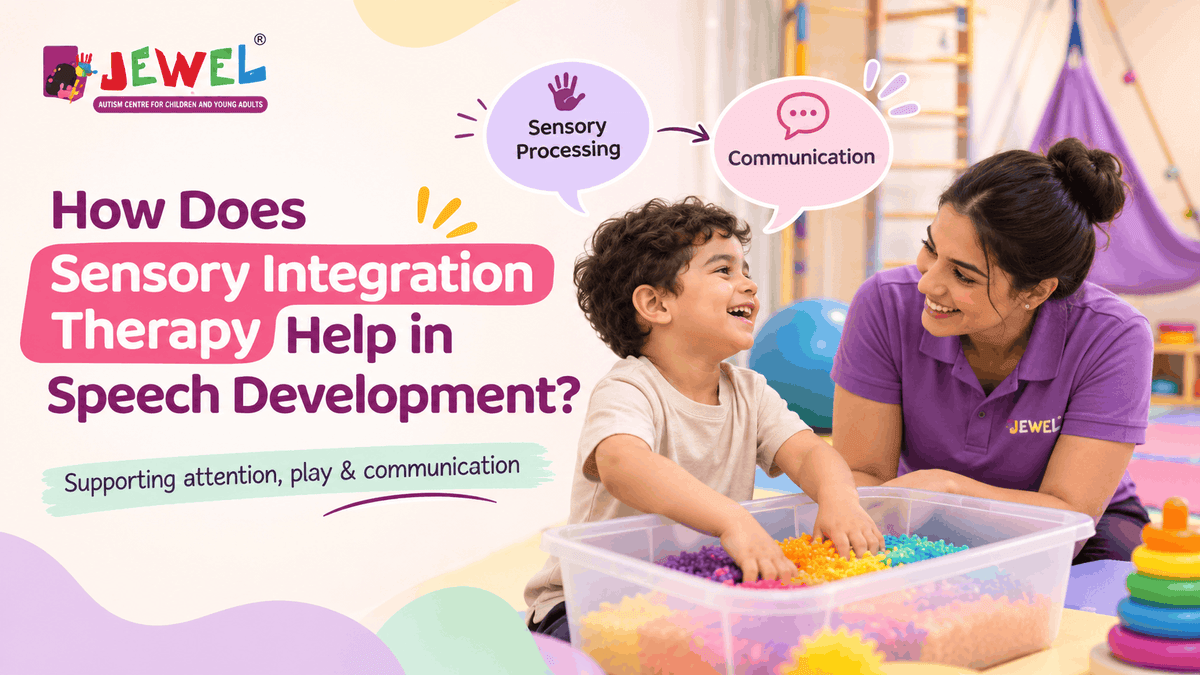
How Does Sensory Integration Therapy Help in Speech Development?
When a child experiences speech delay, most parents immediately think about speech therapy. While speech therapy plays an important role in developing communication skills
By Jewel Centre for Autism ·
When a child experiences speech delay, most parents immediately think about speech therapy. While speech therapy plays an important role in developing communication skills, speech development involves more than simply hearing sounds and learning to pronounce words. A child's ability to process information, respond to sensory experiences, interact with others and understand communication also contributes to their development.
This is where sensory integration therapy for speech delay may play a supportive role, particularly for children with autism who experience sensory processing difficulties.
At JEWEL Autism Centre, we believe parents should understand the different factors that can influence their child's communication development. Understanding the relationship between sensory processing, occupational therapy and speech therapy can help families make more informed decisions about their child's intervention.
What Is Sensory Integration Therapy?
Sensory integration is the process through which the nervous system receives, organises and responds to information from the senses. Children constantly receive sensory information from their surroundings, including sounds, movements, touch, sights and smells.
Some children, particularly children with autism and sensory processing differences, may experience difficulties responding to or organising this information.
Sensory integration therapy is an occupational therapy approach designed to address identified sensory processing challenges. A trained occupational therapist assesses how a child's sensory responses affect everyday activities, learning, play and participation.
For example, a child may:
- Become uncomfortable or overwhelmed by everyday sounds.
- Avoid certain textures, clothing or food.
- Seek constant movement or physical activity.
- Find it difficult to participate in structured activities.
- Have difficulty shifting attention between activities.
These differences can affect how a child participates in interactions and learning opportunities.
How Does Sensory Integration Affect Speech Development?
Speech development is a complex process involving several interconnected abilities. A child needs opportunities to notice communication, understand information, develop language skills and express their needs.
Consider a simple example: A parent calls their child's name.
The child needs to notice the sound, process the information, recognise that someone is communicating with them and respond appropriately.
Think of this process like a computer:
- Input: The computer receives information.
- Processing: The processor organises and interprets the information.
- Output: The computer produces a response.
Similarly, a child receives information through their senses, processes it through the nervous system and responds through communication, movement or behaviour.
This is a simplified analogy, not a literal explanation of brain function. However, it helps parents understand why receiving a sound and responding to it are different abilities.
When sensory processing difficulties affect a child's attention, regulation or participation, they may also affect opportunities for communication and learning.
This is one reason sensory processing and speech development should be considered together when planning a child's intervention.
Why Is Speech Therapy Alone Sometimes Not Enough?
Speech therapy is an important intervention for children experiencing speech and language difficulties. Speech-language therapists work on communication skills, language understanding, expressive language, social communication and speech production.
However, some children require support in other developmental areas alongside speech therapy.
For example, a child may struggle with:
- Paying attention during communication.
- Responding to their name or environmental sounds.
- Participating in interactive play.
- Understanding and following instructions.
- Managing sensory experiences during learning activities.
- Engaging in social interactions.
These challenges may require assessment and intervention from other professionals.
For children with identified sensory processing difficulties, occupational therapy incorporating appropriate sensory integration approaches may complement speech therapy.
The objective is not to replace speech therapy but to address other developmental barriers that may affect the child's ability to participate in communication and learning.
A multidisciplinary approach allows professionals to work towards the child's individual developmental goals.
How Does Occupational Therapy for Speech Delay Help?
Occupational therapy focuses on helping individuals participate in meaningful everyday activities, including playing, learning, eating, dressing and interacting with their surroundings.
In paediatric occupational therapy, sensory integration is one of several possible approaches.
A qualified occupational therapist may use an individualised programme to address sensory processing difficulties that affect a child's everyday functioning.
Depending on the child's assessment, therapy may involve:
1. Improving sensory responses
Therapy activities may help children develop more adaptive responses to different sensory experiences.
2. Supporting attention and participation
When sensory challenges are addressed appropriately, some children may find it easier to participate in structured and interactive activities.
3. Developing body awareness and movement
Activities involving balance, movement and body awareness may support motor planning and participation in play.
4. Encouraging interactive play
Play-based activities can provide opportunities for children to engage with parents, therapists and their surroundings.
5. Supporting everyday independence
Occupational therapy may also address activities such as eating, dressing, personal care and participating in daily routines.
It is important to understand that not every child needs the same intervention. Sensory integration therapy should be recommended following an appropriate assessment by a certified occupational therapist.
What Are the Seven Senses Involved in Sensory Processing?
Parents commonly understand five senses: sight, hearing, smell, taste and touch. However, sensory processing also involves the vestibular and proprioceptive systems.
An additional system, interoception, helps us understand internal body sensations.
These systems contribute to how children experience and respond to their surroundings.
1. Auditory system: Helps children process sounds, voices and environmental noise.
2. Visual system: Helps children process visual information, recognise objects and understand their surroundings.
3. Tactile system: Processes information related to touch, pressure, temperature and texture.
4. Olfactory system: Processes different smells and odours.
5. Gustatory system: Helps children experience and distinguish different tastes.
6. Vestibular system: Provides information about balance, movement and head position.
7. Proprioceptive system: Provides information about body position, muscle movement and force.
Interoception is another important sensory system that helps children recognise internal sensations such as hunger, thirst, temperature and the need to use the toilet.
Difficulties in processing sensory information may influence how a child participates in daily activities, play and social interactions.
What Are Some Sensory Integration Activities for Children?
Sensory integration activities should be selected according to a child's individual assessment and developmental needs. They are not simply games or exercises that every child should perform.
Depending on the child's sensory profile, an occupational therapist may introduce activities such as:
- Movement activities: Supervised swinging, balancing and movement-based play.
- Tactile activities: Exploring different textures through age-appropriate play materials.
- Proprioceptive activities: Pushing, pulling and carrying suitable objects.
- Interactive play: Activities that encourage turn-taking and shared attention.
- Functional activities: Everyday tasks that help children participate more independently.
These activities can create opportunities for engagement, interaction and learning.
Parents should avoid introducing intensive sensory activities without professional guidance, particularly when a child has significant sensory sensitivities or physical difficulties.
Can Sensory Integration Therapy Improve Communication in Children with Autism?
Autism is a neurodevelopmental condition that can affect social communication, interaction, behaviour and sensory experiences.
Some autistic children experience delayed speech, while others may communicate using gestures, pictures, signs or assistive communication devices.
Sensory processing differences may affect how some children participate in communication and social activities.
Research on Ayres Sensory Integration has found evidence of improvements in individual functional goals and participation for autistic children with sensory integration and processing challenges. Research also indicates potential benefits in social, communication and play-related skills.
However, this does not mean sensory integration therapy directly produces spoken language in every child. Its role should be determined according to the child's individual needs and treatment goals.
Speech-language therapy remains important for addressing communication and language development. Occupational therapy may complement it when sensory processing challenges are also present.
The two interventions can work together as part of an individualised developmental programme.
Why Should Parents Be Present During Their Child's Therapy Sessions?
Parents are among the most important people in a child's developmental journey. They understand their child's everyday routines, preferences, communication patterns and challenges better than anyone else.
At JEWEL Autism Centre, parent participation is an important part of the therapy approach.
When parents are present during therapy sessions, they can understand the activities being introduced, observe their child's responses and learn how to support development outside the therapy environment.
Jewel follows a structured parent-inclusive approach:
- Monthly goal sharing: Clinical goals are shared with parents before the monthly therapy sessions begin.
- Parent feedback: Parents are encouraged to provide feedback about their child's progress and everyday performance.
- Goal verification: At the end of the month, parents can review the progress made against the planned goals.
- Quarterly case meetings: Every three months, the clinical team reviews the child's case and discusses progress and future goals with the parents.
This approach encourages transparency, communication and collaboration between parents and therapists.
It also helps parents understand that developmental support does not end when a therapy session finishes. Opportunities for learning and communication continue through everyday interactions at home.
When Should Parents Consider Sensory Integration Therapy?
Parents should consider seeking a professional developmental assessment when they notice concerns such as:
- Delayed speech or limited communication.
- Difficulty responding to their name.
- Limited eye contact or shared attention.
- Unusual responses to everyday sounds or touch.
- Difficulty participating in interactive play.
- Strong reactions to certain sensory experiences.
- Difficulty with everyday activities and routines.
These signs do not automatically indicate autism or a sensory processing disorder. They are reasons to discuss the child's development with an appropriate healthcare professional.
An assessment can help identify the child's strengths, developmental needs and whether occupational therapy, speech therapy or other interventions may be beneficial.
Early identification can help children access appropriate support without unnecessary delays.
Supporting Your Child's Communication Development at JEWEL Autism Centre
Every child has different developmental strengths and challenges. Therefore, speech development should never be approached with a one-size-fits-all treatment plan.
At JEWEL Autism Centre, our parent-inclusive approach focuses on understanding the child's individual needs, setting clinical goals and reviewing developmental progress with families.
Our approach encourages collaboration between parents and the clinical team, with monthly goal sharing, parent feedback and quarterly case reviews.
If your child is experiencing speech delay, communication difficulties or sensory processing challenges, seeking a professional assessment can help you understand the support they may need.
Looking for sensory integration therapy in Dubai? Connect with JEWEL Autism Centre to learn more about our occupational therapy, sensory integration and speech therapy services.
Early understanding, appropriate intervention and active parent participation can make an important difference in supporting a child's developmental journey.
Frequently Asked Questions (FAQs)
1. Can sensory integration therapy help children with speech delay?
Sensory integration therapy may support children with speech delay when sensory processing difficulties affect their attention, interaction, regulation or participation in learning activities. It is generally used alongside speech therapy when clinically appropriate, rather than as a replacement for speech-language intervention.
2. How does sensory integration therapy help in speech development?
Sensory integration therapy addresses how children receive, organise and respond to sensory information. By supporting individual sensory processing needs, occupational therapy may help children participate more effectively in play, social interactions and communication-related activities.
3. Why is speech therapy alone sometimes not enough for children with autism?
Some children with autism experience additional challenges involving sensory processing, attention, motor planning and social interaction. Speech therapy addresses communication skills, while occupational therapy may address other functional challenges that affect participation in communication and learning.
4. What is the difference between occupational therapy and speech therapy?
Occupational therapy focuses on everyday functional skills, sensory processing, motor coordination and participation in daily activities. Speech therapy focuses on communication, language understanding, expressive language, speech production and social communication. Both can complement each other depending on the child's needs.
5. What are the seven senses involved in sensory integration?
The seven commonly discussed sensory systems are visual, auditory, tactile, olfactory, gustatory, vestibular and proprioceptive. Interoception is also an important sensory system that helps children recognise internal body sensations.
6. Can sensory processing difficulties affect communication in autistic children?
Yes. Sensory processing differences may affect attention, responses to sounds, social participation and engagement with others. These factors can influence communication opportunities, although speech and language difficulties in autism have multiple possible contributing factors.
7. Does every child with autism need sensory integration therapy?
No. Every autistic child has individual strengths and developmental needs. Sensory integration therapy may be appropriate when an assessment identifies sensory processing difficulties affecting everyday functioning. A qualified occupational therapist should determine whether this approach is suitable.
8. Why should parents be present during their child's therapy sessions?
Parental presence allows parents to understand therapy activities, observe their child's responses and learn how to support development at home. At JEWEL Autism Centre, parents are involved through therapy participation, monthly goal sharing, progress feedback and quarterly clinical case meetings.
9. At what age should a child start sensory integration therapy?
There is no single age at which every child should begin sensory integration therapy. If parents notice speech delays, communication difficulties or sensory-related challenges, they should seek a developmental assessment as early as possible. Intervention should be based on the child's individual needs.
10. Where can parents find sensory integration therapy in Dubai?
Parents looking for sensory integration therapy in Dubai can explore the services offered by JEWEL Autism Centre. The centre's approach includes occupational therapy, sensory integration and parent participation, with individual clinical goals and regular progress reviews.